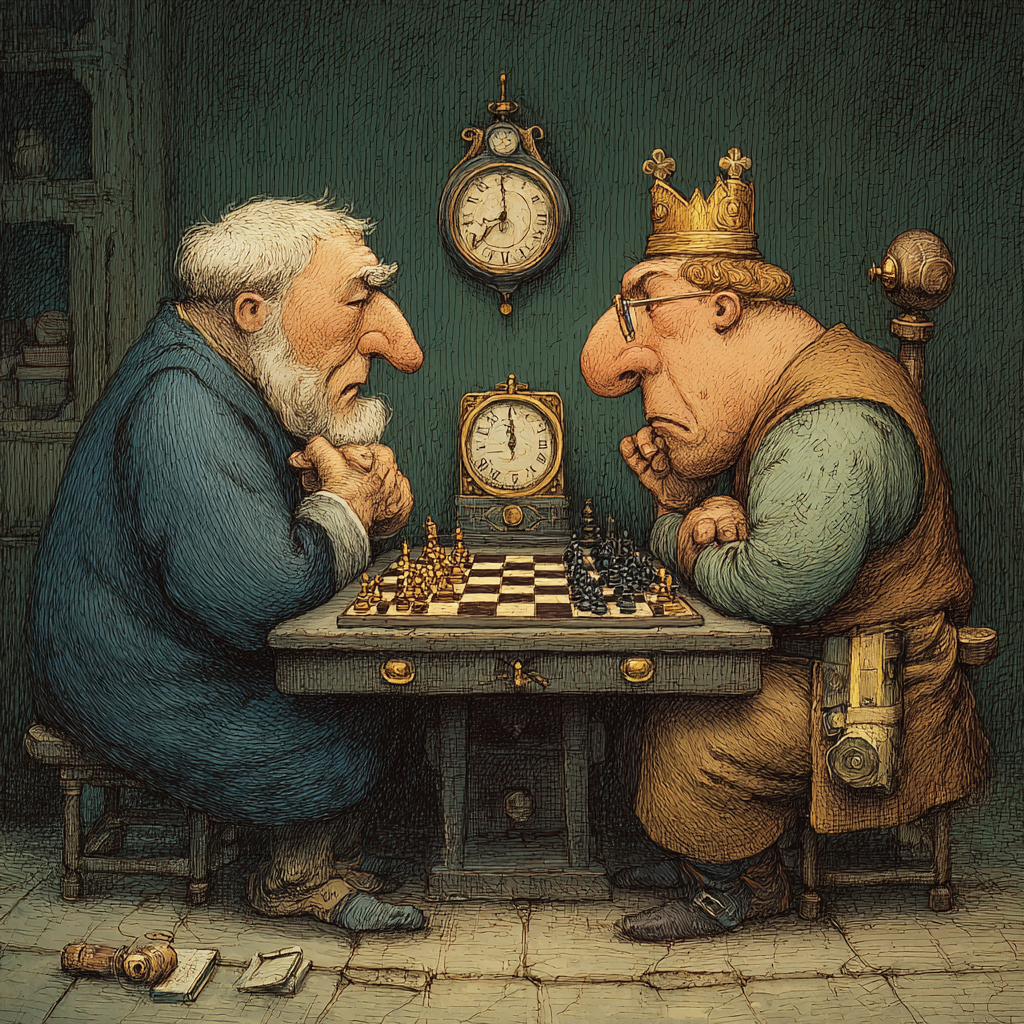
The rhythmic tick of a chess clock has become synonymous with serious competitive play, but the reasons for timing chess games extend far beyond tournament tradition. Chess clocks serve multiple crucial functions that fundamentally transform the nature of the game, creating fair competition, adding psychological pressure, and developing time management skills that separate masters from amateurs. Understanding why chess requires timing reveals deeper insights into what makes competitive chess both challenging and compelling.
The Historical Problem: When Games Lasted Forever
Before chess clocks were introduced in the 1880s, tournament games could theoretically last indefinitely. Players could spend hours contemplating single moves, leading to matches that stretched across multiple days or even weeks. The 1851 London tournament famously featured games lasting over 14 hours, with some positions analyzed for several hours without a single move being played.
The Fairness Issue Without time controls, players with different thinking speeds faced inherent disadvantages. Fast, intuitive players found themselves waiting endlessly for methodical opponents who preferred exhaustive analysis. Conversely, players who benefited from deep calculation felt rushed when opponents moved quickly, creating psychological pressure to match their pace.
This disparity meant that playing style rather than chess skill often determined who could endure marathon sessions. Players with superior stamina or patience gained advantages unrelated to chess ability, undermining the game’s competitive integrity.
Practical Tournament Considerations Organizing chess tournaments without time limits proved nearly impossible. Tournament directors couldn’t schedule rounds effectively when individual games might last anywhere from two hours to two days. Spectators lost interest in events where critical games remained unfinished for extended periods.
The introduction of chess clocks revolutionized tournament organization by making game durations predictable. Organizers could schedule multiple rounds in single days, creating coherent competition formats that attracted both players and sponsors.
Core Functions of Chess Clocks
Modern chess clocks serve several interconnected purposes that enhance competitive play while maintaining the game’s essential character.
Ensuring Fair Time Allocation Chess clocks guarantee that both players receive exactly equal thinking time, eliminating advantages based on natural thinking speed or deliberate time consumption. Each player controls their own time usage while ensuring opponents receive equivalent opportunities for deep analysis.
This equality principle extends beyond simple fairness to philosophical questions about what chess should measure. Clocks ensure that chess tests decision-making ability under consistent constraints rather than rewarding players who can outspend opponents in analysis time.
Creating Practical Game Durations Time controls transform chess from an open-ended intellectual exercise into a structured competitive event with predictable durations. This predictability enables tournament organization, spectator planning, and media coverage that make professional chess viable.
Different time control formats serve various purposes: classical games allow deep strategic development, rapid games test quick decision-making, and blitz formats emphasize pattern recognition and intuitive play. Each format creates different competitive environments that appeal to different player preferences and spectator interests.
Adding Psychological Pressure Time pressure introduces psychological elements that test players’ ability to maintain analytical quality under stress. The awareness of diminishing time creates tension that affects decision-making in ways that unlimited thinking time cannot replicate.
This pressure dimension adds realism to chess competition that mirrors real-world decision-making scenarios where time constraints affect choice quality. Players must balance analytical depth with practical time management, skills that transfer to many professional and personal contexts.
| Time Control Format | Typical Duration | Primary Skills Tested | Psychological Pressure | Strategic Depth | Popular Contexts |
|---|---|---|---|---|---|
| Classical (90+30) | 4-6 hours | Deep calculation, endgame technique | Moderate | Very High | World Championships, elite tournaments |
| Rapid (15+10) | 45-90 minutes | Pattern recognition, time management | High | High | Grand Prix events, online tournaments |
| Blitz (3+2) | 10-15 minutes | Intuition, tactical vision | Very High | Moderate | Casual play, streaming content |
| Bullet (1+0) | 2-4 minutes | Reflex, opening knowledge | Extreme | Low | Online casual play |
| Correspondence | Days-Weeks | Research, computer analysis | Low | Extreme | Postal/email chess |
Time Management as a Chess Skill
Using chess clocks effectively requires developing time management skills that constitute a distinct aspect of chess mastery, separate from but interconnected with traditional chess abilities.
Strategic Time Allocation Strong players learn to allocate time based on position complexity and game phase requirements. Opening moves in familiar variations require minimal time, while critical middlegame positions may justify extended analysis. Endgame positions often demand precise calculation that warrants significant time investment.
The skill involves recognizing which decisions deserve deep analysis versus those that can be handled with general principles and pattern recognition. This meta-cognitive ability—thinking about thinking—distinguishes masters who manage time effectively from those who struggle with clock pressure.
Psychological Time Management Time pressure affects different players in different ways. Some thrive under clock pressure, finding that deadlines improve their focus and decision-making speed. Others struggle with anxiety that impairs calculation accuracy as time dwindles.
Developing clock skills involves understanding your personal response to time pressure and adapting playing style accordingly. Players prone to time pressure anxiety might adopt simpler, more forcing playing styles that reduce complex decision points. Those who perform well under pressure might deliberately save time early to create intimidating positions in time scrambles.
Practical Clock Techniques Experienced players develop specific techniques for managing different clock situations. In time trouble, they prioritize forcing moves that create immediate threats rather than pursuing long-term strategic advantages. They learn to trust intuition when calculation time runs short.
Advanced time management includes psychological elements like creating time pressure for opponents through rapid play in familiar positions, then slowing down when opponents reach unfamiliar territory. These competitive tactics add strategic depth beyond pure chess analysis.
Different Time Control Formats and Their Purposes
Chess has evolved multiple time control formats that create distinct competitive environments, each testing different combinations of chess skills and personal qualities.
Classical Time Controls Classical games, typically featuring 90 minutes plus 30-second increments, allow for the deepest strategic and tactical development. These time controls enable complex long-term planning, exhaustive tactical calculation, and precise endgame technique that faster formats cannot accommodate.
Classical chess most closely resembles the ideal of pure chess competition where the strongest analytical abilities determine outcomes. However, even classical games require time management skills, as players must distribute their thinking time effectively across an entire game.
Rapid and Blitz Formats Faster time controls emphasize different chess skills while maintaining competitive integrity. Rapid chess (typically 15-25 minutes per side) tests players’ ability to find strong moves quickly while retaining strategic coherence.
Blitz chess (under 10 minutes per side) primarily tests pattern recognition, tactical vision, and intuitive decision-making. While some chess purists argue that blitz doesn’t represent “real” chess, these formats develop valuable skills and provide entertainment that attracts broader audiences to chess.
Increment vs. Delay Systems Modern digital clocks offer sophisticated timing methods beyond simple countdown formats. Increment systems add time after each move, preventing time pressure from reaching critical levels while maintaining time constraints. Delay systems provide brief periods to make moves without losing time from the main allocation.
These systems balance the competing goals of preventing endless games while avoiding situations where strong players lose purely due to time expiration in winning positions. The choice between different timing methods affects game character significantly.
| Clock System | Mechanism | Time Pressure Pattern | Best For | Drawbacks | Tournament Usage |
|---|---|---|---|---|---|
| Simple Countdown | Fixed time decreases with each move | Increases steadily throughout game | Traditional feel | Can end games artificially | Rare in modern play |
| Fischer Increment | Adds time after each move | Moderate, allows recovery | Balanced competitive play | Complex for beginners | Very common |
| Bronstein Delay | Delays time deduction briefly | Similar to increment | Simpler than increment | Less time for longer thinking | Moderate usage |
| Hourglass | Time flows between players | Constant total pressure | Fast casual games | Can create unfair situations | Rare, mainly casual |
| Progressive | Time increases each move | Decreases as game progresses | Long strategic games | Complex administration | Very rare |
Psychological and Competitive Aspects
Chess clocks introduce psychological elements that fundamentally alter the competitive landscape, creating pressure and strategic opportunities that don’t exist in untimed play.
Pressure Performance and Stress Management Time pressure reveals how players perform under stress, testing mental resilience alongside chess ability. Some players’ performance improves under time pressure as focus sharpens, while others struggle with anxiety that impairs decision-making quality.
This psychological dimension adds realism to chess competition by simulating pressure conditions that exist in many real-world scenarios. The ability to maintain analytical quality while managing stress represents a valuable skill that extends beyond chess.
Intimidation and Psychological Warfare Experienced competitors use time management as a psychological weapon. Playing quickly in familiar positions can create pressure on opponents who feel compelled to match the pace. Conversely, taking significant time on routine moves can suggest deep preparation or superior understanding.
These psychological tactics add strategic depth to competitive chess while testing players’ mental resilience and confidence. Learning to ignore opponent psychological pressure while leveraging time effectively requires maturity and competitive experience.
Clock-Induced Blunders and Drama Time pressure often produces dramatic momentum shifts when strong players make serious errors under time constraints. These “time scrambles” create exciting spectator moments while testing players’ ability to find reasonable moves quickly.
The possibility of losing winning positions due to time pressure adds tension that makes chess more compelling for both players and spectators. However, this same element can feel frustrating when technical skills can’t be demonstrated due to time constraints.
Modern Digital Clocks and Advanced Features
Contemporary chess clocks offer sophisticated features that enhance tournament organization and player experience while maintaining competitive integrity.
Programmable Time Controls Digital clocks can implement complex time control systems with multiple time periods, different increment rates, and conditional time additions. This flexibility allows tournament organizers to design time controls that balance competitive needs with practical constraints.
Advanced features include time delay options, move counters, and automatic time forfeit detection that reduce administrative burden on tournament directors while ensuring accurate time management.
Data Collection and Analysis Modern tournament clocks can record time usage patterns that provide valuable data for players and researchers. Analyzing how time allocation affects performance helps players optimize their clock management strategies.
Tournament organizers use time data to evaluate different time control formats and their effects on game quality, player satisfaction, and spectator engagement.
| Clock Feature | Tournament Value | Player Benefit | Complexity | Cost Impact | Adoption Rate |
|---|---|---|---|---|---|
| Multiple Time Periods | High | Moderate | High | Moderate | Common |
| Move Counting | Very High | Low | Low | Low | Universal |
| Time Usage Logging | Moderate | High | Moderate | Low | Growing |
| Network Connectivity | High | Low | High | High | Limited |
| Mobile App Integration | Moderate | Moderate | High | Moderate | Emerging |
Educational and Developmental Benefits
Chess clocks provide educational benefits that extend beyond competitive play, developing life skills and cognitive abilities that prove valuable in many contexts.
Decision-Making Under Pressure Learning to make quality decisions under time constraints develops mental skills that transfer to academic, professional, and personal situations. The ability to balance thoroughness with efficiency represents a crucial life skill that chess clocks help develop.
Students who learn chess with proper time management often show improved performance in timed academic tests and better ability to prioritize tasks under deadline pressure.
Risk Assessment and Resource Management Time allocation decisions require constant risk assessment: Is this position complex enough to justify extended analysis? Will spending time here leave insufficient time for later critical decisions? These judgments develop sophisticated resource management thinking.
The meta-cognitive skills involved in monitoring your own thinking process and adjusting analytical depth based on available resources apply directly to project management, academic planning, and professional development.
Stress Resilience and Performance Optimization Regular experience with time pressure builds psychological resilience and teaches players to maintain performance quality under stress. Learning to control anxiety and channel pressure productively develops emotional regulation skills.
These stress management abilities prove valuable in competitive academic environments, job interviews, public speaking, and other high-pressure situations where performance quality matters.
| Life Skill | Chess Clock Training | Real-World Application | Development Timeline | Transfer Effectiveness |
|---|---|---|---|---|
| Time Management | Allocating analysis time across moves | Project deadlines, exam preparation | Months | High |
| Pressure Performance | Playing accurately in time trouble | Job interviews, presentations | Months-Years | High |
| Risk Assessment | Deciding when to spend time analyzing | Investment decisions, strategic planning | Years | Moderate |
| Multitasking | Managing time while calculating variations | Professional project management | Months | Moderate |
| Stress Regulation | Controlling anxiety in time pressure | Performance under deadlines | Years | High |
Special Considerations and Variations
Different chess contexts require modifications to standard clock usage, creating specialized timing systems that serve particular needs.
Online Chess Adaptations Internet chess platforms face unique timing challenges due to connection latencies and interface delays. Online clocks typically add small time compensations for network delays while implementing anti-cheating measures that monitor unusual time patterns.
The convenience of online play has popularized ultra-fast time controls that would be impractical in over-the-board play, creating new competitive formats that emphasize speed and reflex over deep analysis.
Accessibility and Special Needs Chess clocks must accommodate players with various physical limitations. Specialized clocks offer large buttons, audio signals, and interface modifications that enable participation by players with visual, hearing, or motor impairments.
Tournament regulations provide time compensation for players requiring assistance with clock operation, ensuring that physical limitations don’t create unfair disadvantages in competitive play.
Youth and Educational Contexts Teaching chess to children requires modified time controls that maintain engagement without creating excessive pressure. Shorter games with generous time allocations help young players develop clock awareness gradually while focusing primarily on chess learning.
Educational chess programs often use clocks to teach time management skills alongside chess improvement, creating structured learning environments that develop multiple cognitive abilities simultaneously.
Conclusion: The Clock as Chess’s Great Equalizer
Chess clocks represent one of the most important innovations in chess history, transforming the game from an intellectual pastime into a dynamic competitive sport. By ensuring equal time allocation, creating manageable game durations, and adding psychological pressure, clocks have made modern chess possible while preserving its essential character.
The clock serves as chess’s great equalizer, ensuring that victory depends on the quality of decisions made under consistent constraints rather than advantages based on thinking speed or patience. This fairness principle has enabled chess to develop into a global competitive sport with standardized rules and meaningful comparisons across different players and eras.
Beyond competitive considerations, chess clocks develop valuable life skills including time management, decision-making under pressure, and stress resilience. These educational benefits make timed chess valuable for player development while creating more engaging spectator experiences that help chess reach broader audiences.
The evolution from mechanical wind-up clocks to sophisticated digital devices reflects chess’s adaptation to modern technology while maintaining its core competitive principles. As chess continues evolving through online platforms and new formats, the clock remains essential for creating fair, exciting, and meaningful competition that tests the full range of human chess abilities.