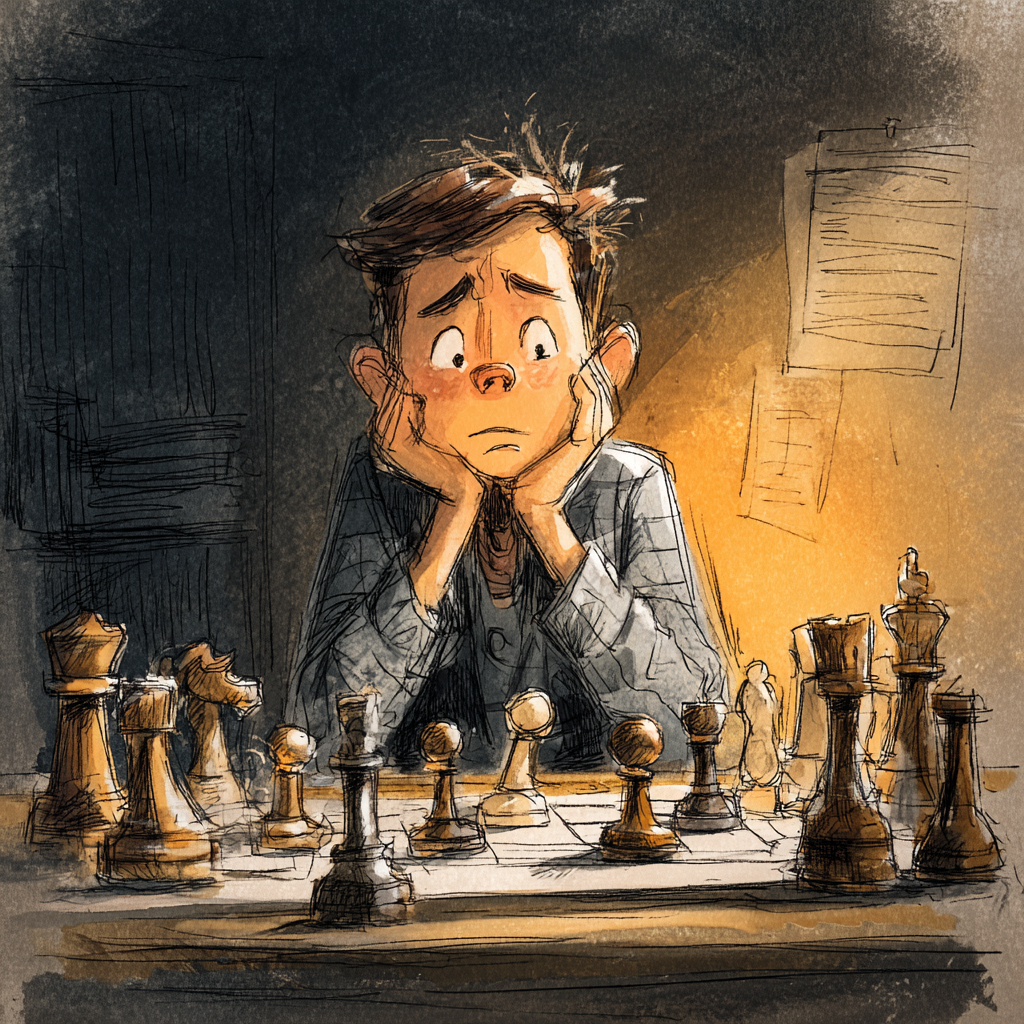
Chess has a unique ability to simultaneously captivate and torment its players. Unlike other games where luck, teammates, or equipment can be blamed for poor performance, chess strips away all external factors and presents the naked truth: when you lose, it’s entirely your fault. This brutal honesty, combined with the game’s infinite complexity and the weight of centuries of accumulated knowledge, creates a perfect storm of frustration that has driven countless players to the brink of madness. Understanding why chess generates such intense emotional responses reveals deeper truths about human psychology, learning, and our relationship with intellectual challenges.
The Perfect Storm of Psychological Pressure
Chess frustration stems from a unique combination of psychological factors that rarely converge in other activities. Unlike physical sports where natural talent, training conditions, or equipment quality can influence outcomes, chess presents a pure test of mental ability under pressure. Every move represents a public declaration of your thought process, permanently recorded for analysis and judgment.
The game’s deterministic nature means that every loss results from inferior decision-making. There are no bad referees, unlucky bounces, or equipment failures to soften the blow of defeat. When you blunder your queen or miss a simple checkmate, the responsibility lies entirely with your analytical abilities and concentration. This absolute accountability creates psychological pressure that few other activities can match.
Chess also forces players to confront their intellectual limitations in real-time. The gap between what you know you should do and what you can actually calculate becomes painfully apparent during games. You might understand strategic principles perfectly but find yourself unable to apply them under time pressure. This disconnect between theoretical knowledge and practical execution generates deep frustration with your own mental processes.
The public nature of chess performance amplifies emotional stress. Every move is visible to opponents and observers, creating a transparent record of your thought process quality. Brilliant moves earn recognition, but blunders become permanent reminders of mental failure. The rating system quantifies your performance with mathematical precision, creating objective measurements of intellectual capability that can feel like judgments of personal worth.
The Complexity Trap: When Infinite Possibilities Become Overwhelming
Chess’s astronomical complexity creates a paradoxical relationship with player satisfaction. The game offers virtually unlimited depth, ensuring that mastery remains perpetually out of reach even for world champions. This infinite complexity initially attracts players seeking intellectual challenge but eventually becomes a source of profound frustration as the scope of ignorance becomes apparent.
Consider the mathematical reality: after just ten moves by each side, there are more possible chess positions than atoms in the observable universe. This mind-bending complexity means that perfect play remains theoretically impossible for human minds. Even grandmasters regularly discover that positions they thought they understood completely contain hidden tactical or strategic elements that escaped their analysis.
The knowledge accumulation required for chess improvement feels endless. Opening theory extends dozens of moves deep in major variations. Tactical pattern libraries contain thousands of motifs. Endgame theory includes countless theoretical positions requiring precise technique. Strategic principles fill volumes of chess literature. No matter how much you study, vast areas of chess knowledge remain unexplored, creating persistent feelings of inadequacy.
This complexity creates analysis paralysis during games. Faced with multiple reasonable candidate moves, players often spend excessive time calculating variations that lead nowhere productive. The awareness that better moves likely exist somewhere in the position creates anxiety that prevents decisive action. Time pressure compounds this effect, forcing decisions before analysis feels complete.
The improvement paradox in chess generates particular frustration. As players advance, they become more aware of their weaknesses and mistakes. A beginner might feel satisfied playing reasonable moves, but intermediate players recognize dozens of superior alternatives they failed to consider. This increased awareness often makes players feel like they’re getting worse even as their objective strength improves.
The Rating System: A Double-Edged Sword of Measurement
Chess rating systems provide precise measurement of playing strength that enables fair competition and tracks improvement over time. However, this same precision creates psychological pressure that transforms rating points into measures of self-worth and intellectual capability.
Rating fluctuations feel personal in ways that other performance metrics don’t. Losing rating points after poor games can feel like public acknowledgment of intellectual decline. The mathematical precision of rating calculations makes these losses feel objective and irrefutable rather than temporary setbacks. Players often obsess over rating changes, checking their numbers compulsively after each game.
The psychology of rating protection creates defensive playing styles that prioritize avoiding losses over pursuing victories. Players begin avoiding stronger opponents or unfamiliar positions to preserve rating points. This defensive mindset often leads to passive, uninspired play that fails to generate winning chances while remaining vulnerable to opponent pressure.
Rating plateaus represent particularly frustrating experiences. Players may remain at similar strength levels for months or years despite dedicated study and practice. These plateaus feel like evidence of natural ability limitations rather than temporary learning phases. The visible stagnation in rating numbers can undermine motivation and create self-doubt about chess potential.
The comparison trap created by rating systems amplifies frustration. Players constantly compare their ratings to peers, friends, or admired masters. These comparisons often ignore factors like playing frequency, study time, or natural learning rates. Social media and online platforms make these comparisons unavoidable, creating persistent reminders of relative chess weakness.
The Perfectionist’s Nightmare: Blunders and Missed Opportunities
Chess attracts perfectionist personalities drawn to the game’s logical structure and deterministic outcomes. However, the game’s complexity ensures that perfect play remains impossible, creating constant tension between perfectionist desires and practical limitations.
Blunders represent the most psychologically devastating aspect of chess. A single move can transform winning positions into losses, destroying hours of careful play in seconds. The finality of these mistakes feels crushing because, unlike other activities where errors can be corrected or mitigated, chess blunders often prove irreversible.
The transparency of blunders amplifies their emotional impact. Computer analysis after games reveals exactly how devastating mistakes were, showing precise evaluations that quantify the damage. A position evaluated as “+3.5” (clearly winning) might become “-5.2” (completely lost) after a single move. This mathematical precision makes mistakes feel more severe than subjective assessments would suggest.
Missed tactical opportunities create unique frustration because they represent failures of pattern recognition rather than strategic understanding. Missing a simple checkmate in three moves feels worse than making a subtle positional error because tactical solutions seem more concrete and discoverable. The “I should have seen that” feeling haunts players long after games end.
Time pressure transforms chess from pure logical analysis into a race against the clock that introduces additional error sources. Players may calculate variations correctly but lack time to find the best moves. The combination of time shortage and position complexity creates conditions where even strong players make elementary mistakes that would be impossible in casual analysis.
| Frustration Source | Psychological Impact | Frequency | Severity | Recovery Time | Prevention Difficulty |
|---|---|---|---|---|---|
| Major Blunder | Devastation, self-doubt | Moderate | Very High | Days-Weeks | Very High |
| Time Trouble | Anxiety, rushed decisions | High | High | Hours-Days | Moderate |
| Rating Loss | Deflation, worth questioning | High | Moderate-High | Days | High |
| Missed Tactics | Frustration, pattern failure | High | Moderate | Hours | Moderate |
| Plateau Period | Stagnation, motivation loss | Low | High | Weeks-Months | Very High |
| Preparation Failure | Inadequacy, study doubt | Moderate | Moderate | Days | Moderate |
| Technical Loss | Precision frustration | Moderate | Moderate-High | Hours-Days | High |
| Opponent Luck | Injustice, unfairness | Low | Low-Moderate | Hours | Low |
The Social and Competitive Dimensions of Chess Frustration
Chess’s individual nature intensifies competitive pressure by eliminating team support and shared responsibility. When you lose, there are no teammates to share blame or offer immediate comfort. The isolation of chess competition can make defeats feel more personal and devastating than team sport losses.
The chess community’s culture often emphasizes intellectual superiority and analytical precision in ways that create additional pressure. Strong players are expected to maintain consistent performance levels and demonstrate superior calculation abilities. This cultural expectation can make normal human errors feel like intellectual failures rather than natural learning experiences.
Online chess platforms have intensified competitive pressure by making games available 24/7 and providing instant rating feedback. The convenience of online play encourages excessive gaming sessions where emotional control deteriorates and frustration accumulates. The anonymous nature of online opponents can also reduce empathy and increase competitive aggression.
Chess’s rich analytical tradition means that every game exists within a context of centuries of accumulated knowledge. Players feel pressure to demonstrate familiarity with established theory while simultaneously finding original ideas. This tension between respecting tradition and seeking innovation creates performance anxiety that can inhibit natural playing ability.
The delayed gratification inherent in chess improvement creates sustained frustration periods. Unlike activities that provide immediate skill feedback, chess improvement often requires months or years of study before rating increases become apparent. This delayed feedback loop can undermine motivation and create doubt about improvement strategies.
Cognitive Overload and Mental Fatigue
Chess places enormous demands on working memory, pattern recognition, and calculation abilities simultaneously. Managing these cognitive loads while maintaining emotional control creates mental fatigue that accumulates over games and tournaments. This fatigue often leads to deteriorating decision quality that generates additional frustration.
The multitasking requirements of chess exceed most other intellectual activities. Players must simultaneously track piece positions, calculate tactical variations, evaluate strategic factors, manage time allocations, and maintain emotional equilibrium. This cognitive juggling act becomes particularly challenging during critical positions where multiple factors require attention.
Decision fatigue affects chess performance as games progress and players face countless choices requiring analytical evaluation. Each move decision depletes mental resources needed for subsequent calculations. Late-game blunders often result from decision fatigue rather than position complexity, creating frustration about preventable errors.
The metacognitive demands of chess—thinking about your thinking—add another layer of mental complexity. Strong players constantly monitor their calculation accuracy, time usage, and emotional state while analyzing positions. This self-awareness, while beneficial for improvement, can create additional cognitive load that contributes to mental fatigue.
The Paradox of Chess Improvement
Chess improvement follows non-linear patterns that create frustrating learning experiences. Players may study intensively for weeks without seeing rating gains, then experience sudden breakthroughs that seem unrelated to recent efforts. This unpredictable improvement pattern makes it difficult to maintain motivation during slow progress periods.
The “curse of knowledge” affects advancing chess players who become aware of their weaknesses as understanding deepens. Beginners may feel satisfied with basic play, but intermediate players recognize countless improvements they failed to make. This increased awareness can make players feel like they’re regressing even while objectively improving.
Study efficiency varies dramatically among different chess topics and individual learning styles. Some players improve rapidly through tactical training while others respond better to positional study. The trial-and-error process of finding effective improvement methods can be frustrating and time-consuming.
The gap between understanding and application creates persistent frustration for developing players. You might understand strategic principles perfectly during analysis but fail to apply them during actual games. This disconnect between theoretical knowledge and practical execution feels like a fundamental learning failure.
| Improvement Challenge | Description | Emotional Impact | Duration | Solutions | Success Rate |
|---|---|---|---|---|---|
| Plateau Breaking | Stagnant rating despite study | High frustration | Months-Years | Varied study methods | Moderate |
| Theory Application | Can’t use learned concepts | Moderate frustration | Weeks-Months | Practical training | High |
| Time Management | Chronic time pressure | High stress | Ongoing | Clock training | Moderate |
| Calculation Accuracy | Frequent analytical errors | High frustration | Months | Systematic practice | High |
| Opening Memory | Forgetting prepared lines | Moderate stress | Ongoing | Spaced repetition | High |
| Endgame Technique | Converting advantages | High frustration | Months-Years | Theoretical study | Moderate |
| Pattern Recognition | Missing tactical motifs | Moderate frustration | Months | Puzzle training | High |
| Pressure Performance | Playing worse in important games | High stress | Ongoing | Mental training | Low-Moderate |
The Technology Factor: Engines and Perfect Analysis
Modern chess engines provide perfect analysis that reveals every mistake with mathematical precision. While this analytical power aids improvement, it also creates new sources of frustration by highlighting the gap between human and optimal play.
Post-game engine analysis can be psychologically brutal, showing exactly how many mistakes occurred and their precise impact on game outcomes. Seeing that you made seventeen inaccuracies and three blunders in a single game creates feelings of analytical inadequacy that purely human analysis might not generate.
The accessibility of perfect analysis creates unrealistic expectations about human performance. Players may feel frustrated about making moves that engines evaluate as slightly inferior, even when these moves follow sound strategic principles and would be difficult for humans to refute practically.
Engine dependency can undermine confidence in human analytical abilities. Players may begin doubting their evaluations unless confirmed by computer analysis. This technological crutch can actually impede chess improvement by reducing reliance on natural pattern recognition and intuitive understanding.
The Existential Dimension: Chess and Identity
For serious players, chess often becomes intertwined with personal identity in ways that amplify emotional responses to performance fluctuations. Chess success or failure can feel like validation or negation of intellectual self-worth rather than simple game outcomes.
The intellectual nature of chess creates associations between playing strength and general intelligence that may not exist in other activities. Poor chess performance can trigger broader self-doubt about analytical abilities, problem-solving skills, and intellectual capacity.
Chess’s reputation as a measure of mental prowess adds pressure that transforms recreational activity into identity validation. Players may feel that chess weakness reflects broader personal inadequacies rather than specific skill deficits in a complex game.
The time investment required for chess improvement creates sunk cost emotional attachments that intensify frustration. After spending hundreds of hours studying chess, poor performance feels like evidence of wasted effort rather than normal learning variation.
Coping Strategies and Emotional Management
Understanding chess frustration sources enables development of coping strategies that preserve enjoyment while pursuing improvement. Successful chess players learn to manage emotional responses to setbacks while maintaining motivation for continued development.
Perspective Management Viewing chess as a journey of continuous learning rather than a test of fixed ability helps maintain motivation during difficult periods. Embracing mistakes as learning opportunities rather than personal failures reduces emotional impact of poor performances.
Process Focus Concentrating on decision-making quality rather than game outcomes helps maintain emotional equilibrium. Good moves that lead to losses feel less frustrating than poor moves that happen to succeed through opponent errors.
Realistic Expectations Understanding that chess improvement follows non-linear patterns with inevitable plateaus and setbacks helps maintain motivation during difficult periods. Accepting that even masters make frequent mistakes reduces pressure for perfect play.
Emotional Regulation Techniques Developing mindfulness practices, breathing exercises, and mental reset routines helps manage tilt and emotional volatility during games. These skills prove valuable both in chess and other high-pressure situations.
The Flip Side: Why We Keep Playing Despite the Frustration
Despite its frustrating aspects, chess provides rewards that keep players returning despite emotional setbacks. The same complexity that creates frustration also generates endless fascination and intellectual stimulation.
Chess offers pure intellectual competition that appeals to analytical minds seeking challenge and growth. The game’s logical structure provides satisfaction that transcends temporary emotional difficulties. Beautiful games and brilliant moves create joy that compensates for frustrating losses.
The improvement process, while often frustrating, provides genuine satisfaction when breakthroughs occur. Understanding new concepts, seeing patterns more clearly, and calculating more accurately create intellectual pleasure that justifies study efforts.
Chess’s social aspects provide community and shared experience with fellow enthusiasts who understand the game’s unique challenges and rewards. The chess community offers support, encouragement, and perspective that help players manage frustration and maintain motivation.
Conclusion: Embracing the Struggle
Chess frustration stems from the game’s unique combination of infinite complexity, perfect accountability, precise measurement, and intellectual demands. These same characteristics that create emotional challenges also generate the deep satisfaction and intellectual growth that make chess worthwhile.
Understanding frustration sources helps players develop healthier relationships with chess performance and improvement. Accepting that frustration is inherent to chess rather than evidence of personal inadequacy enables more enjoyable and sustainable chess engagement.
The key to managing chess frustration lies in embracing the struggle as part of the game’s appeal rather than an obstacle to enjoyment. Chess frustration reflects the game’s capacity to challenge human limits and provide genuine intellectual growth. Players who learn to view setbacks as learning opportunities and maintain perspective about chess’s role in their lives can enjoy the game’s rewards while minimizing its emotional costs.
Chess will always be frustrating because it confronts us with our intellectual limitations while demanding our best efforts. This honest feedback, while sometimes painful, provides opportunities for genuine growth and self-understanding that few other activities can match. The frustration is not a bug in the chess experience—it’s a feature that makes victory sweeter and improvement more meaningful.